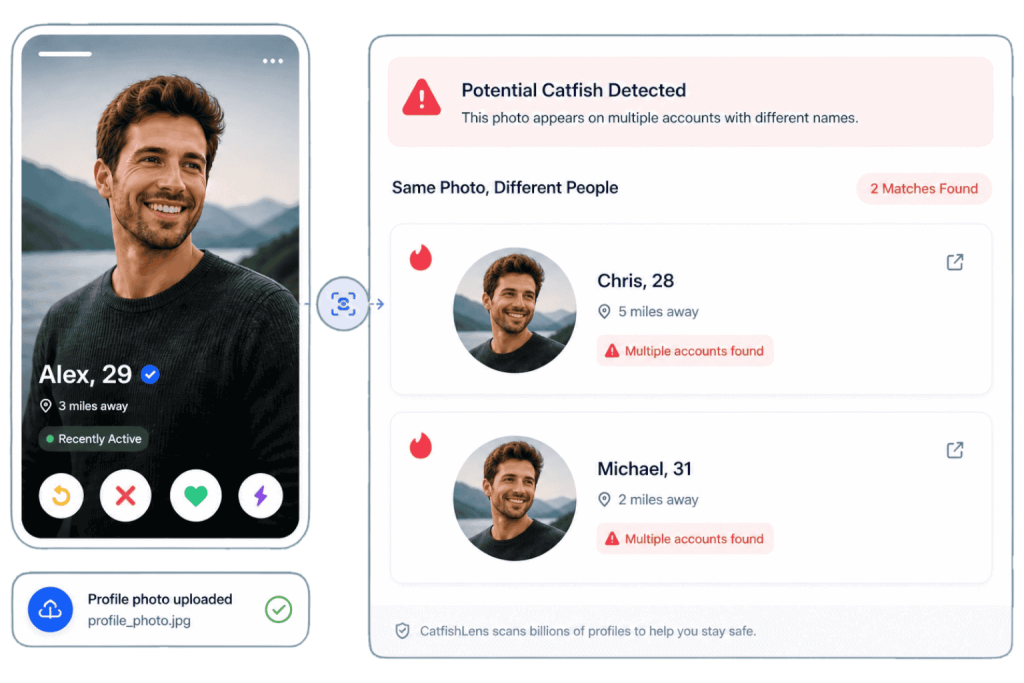
Why Catfishing Is a Serious Online Dating Concern
Online dating allows people to build connections with individuals they may never have encountered in everyday life. A conversation can begin with a simple message and quickly become a regular exchange. However, the distance created by online communication can also make it easier for dishonest people to hide behind false identities.
Catfishing is one of the most common concerns. A catfish may use another person’s photograph, invent personal details, or create an entirely fictional identity. Because the person may spend considerable time building emotional trust, the deception is not always obvious at the beginning.
This is why some online daters choose to verify information before becoming deeply involved. Learning to search Facebook profiles by face can provide another way to investigate a profile photograph and look for potential social-media connections.
Face2social supports profile-photo analysis across Facebook, Instagram, X, and TikTok, giving users another source of information when evaluating whether an online identity appears consistent.
What Makes a Catfish Profile Difficult to Recognize?
A catfish does not necessarily create a profile that looks suspicious. In fact, deceptive accounts can be carefully designed to appear genuine.
The profile may contain attractive photographs, an interesting biography, and details about work, hobbies, family, or travel. The person may also communicate frequently and appear emotionally interested.
Some catfish accounts are created using photographs stolen from genuine social-media users. Others may use a real person’s photograph while inventing a completely different background.
Because the information can appear convincing, users may need to look beyond the original dating profile to identify potential inconsistencies.
Why Profile Photos Can Provide Useful Clues
A photograph can sometimes reveal connections that are difficult to find through names or usernames. Many people reuse their profile pictures across different social-media platforms.
If the same image appears across multiple accounts with consistent information, it may provide additional context about an online identity. If it appears alongside a completely different name or background, however, it may raise questions.
When you search Facebook profiles by face, the photograph becomes the starting point for investigating potential profile connections. Face2social can analyze profile photos across Facebook, Instagram, X, and TikTok.
The purpose is not to automatically determine that someone is a catfish. Instead, visual searching can provide clues that users can compare with information from the dating profile.
How Face2social Can Support Profile Checks
Face2social provides profile-photo analysis across supported social-media platforms. Users can analyze a profile photograph and consider potential matches that may help them understand an online identity.
For example, imagine that you meet someone through a dating app and the relationship begins developing quickly. The person appears friendly, but some details about their story seem unclear.
You can investigate the profile photograph and compare potential social-media matches with the information they have provided. If the available details are consistent, this may offer additional reassurance. If important information differs, you may have a reason to ask questions.
This makes Face2social a useful supporting resource when checking an online identity.
Looking for Stolen Photographs
One of the strongest reasons to investigate a profile photograph is the possibility that it has been copied from another person.
A scammer can take a photograph from a genuine social-media account and use it on a fake dating profile. The individual shown in the image may have no relationship with the account at all.
If a visual search produces a potential profile associated with another name, it is worth examining the result carefully.
Searching Facebook profiles by face can help users investigate whether a dating photograph may be connected with other social-media profiles. However, finding the same photograph elsewhere does not automatically prove that a scam is taking place.
The image could belong to the same person, who may simply use multiple accounts. Context is essential.
Identifying Inconsistencies Between Profiles
Catfishing often involves more than a stolen photograph. The person may also provide false information about their location, occupation, relationship status, age, or personal history.
Comparing a dating profile with potential social-media matches can help reveal inconsistencies.
For example, someone may claim to live in one city while a potential profile associated with the same photograph contains information about another location. This does not necessarily prove deception. People move and old profiles can remain unchanged.
However, several significant contradictions deserve greater attention. If the person’s name, photograph, location, and personal story all conflict, it may be sensible to slow down before continuing the relationship.
Outdated Photos Can Create Misleading Expectations
Not every questionable profile involves malicious behavior. Some people simply use old photographs.
A person may prefer an older image or forget to update their dating account. Although this is different from impersonation, it can still create unrealistic expectations.
Someone preparing for a first meeting may believe they know what their online match currently looks like, only to discover that the photograph is several years old.
Looking at other profile photographs can sometimes provide additional context about the image being used. This can help users understand whether the photograph appears current or outdated.
The goal is not to judge someone’s appearance. It is to make sure expectations are based on reasonably accurate information.
Watch for Other Catfishing Warning Signs
Visual information should be combined with behavioral clues. A person may repeatedly avoid video calls, cancel plans, refuse reasonable questions, or provide stories that change over time.
Another major warning sign is financial pressure. Romance scammers often build emotional trust before claiming that they need money for an emergency, travel, medical expenses, or another urgent situation.
If someone you have met online starts requesting money, be extremely cautious. Emotional connection should never be used as a reason to ignore financial safety.
A visual search cannot identify every scam, but it can contribute to a broader process of evaluating whether an online relationship appears trustworthy.
Understanding the Limits of Visual Searching
It is important to use visual search results responsibly. A potential match does not automatically prove that two accounts belong to the same person.
People can look similar, use the same photograph legitimately, or have old profiles with information that is no longer current.
Likewise, failing to find a match does not prove that an account is genuine. Someone may use different photographs across platforms or have little public social-media activity.
Therefore, when you search Facebook profiles by face, treat the results as clues rather than final evidence.
The most reliable approach is to combine visual information with consistent personal details, direct communication, and sensible online safety practices.
What to Do When You Find a Suspicious Match
Suppose you discover a potential profile that uses the same photograph but has a different name. Instead of immediately accusing the person, first examine the available information.
Check whether the photograph actually appears to be identical. Consider whether the account might be old or whether the person may have a legitimate reason for using another name.
If you decide to ask about it, give the person an opportunity to explain. A genuine explanation may resolve the concern.
However, if the person repeatedly changes their story, becomes aggressive, or pressures you to ignore the information, you may want to step away from the relationship.
You are never obligated to continue communicating with someone when you do not feel comfortable.
Protecting Your Own Information
Identity checking should go hand in hand with protecting your own privacy. Avoid sharing passwords, banking information, identification documents, or other sensitive details with someone you have only met online.
Be cautious about sharing your home address or other information that could compromise your personal safety.
If you decide to meet someone, arrange the first meeting in a public place and tell someone you trust about your plans. A video call beforehand can also provide another opportunity to confirm that the person matches their online identity.
These precautions are simple but can make a significant difference.
Let Trust Develop Gradually
Healthy online relationships do not require immediate trust. It is perfectly reasonable to take time to learn about someone before making important decisions.
A genuine person should generally understand the importance of reasonable verification. Someone who becomes angry simply because you want to confirm basic information may be giving you another reason to reconsider the relationship.
Face2social can support this gradual approach by allowing users to investigate profile photos across Facebook, Instagram, X, and TikTok.
When you search Facebook profiles by face, remember that the purpose is to gather additional information, not to make an instant judgment.
Conclusion: Use Visual Clues Wisely
Catfishing can be difficult to recognize because fake identities may look convincing and involve significant emotional investment. Stolen photographs, invented personal details, outdated images, and romance scams can all create risks for online daters.
Learning to search Facebook profiles by face can provide another way to investigate a dating profile photograph and look for potential social-media connections. Face2social allows users to analyze profile photos across Facebook, Instagram, X, and TikTok and use potential matches as additional clues.
The safest approach is to combine visual searches with careful communication, consistent information, video calls, financial boundaries, and privacy protection. A potential match should never be treated as conclusive proof on its own.
By taking time to investigate unusual profiles and allowing trust to develop naturally, online daters can become better prepared to recognize potential catfishing and make more informed decisions before taking a relationship offline.
About the Author